It was a busy summer for the DISCO Lab, with two fantastic visitors joining us for seminars and scientific discussions.
We were delighted to welcome Deborah Fygenson from UC Santa Barbara, currently visiting research faculty at the University of Chicago Center for the Origins of Life. Deborah gave a Hamilton Institute seminar entitled Semi-permeable nucleic acid membranes: the missing link to an all-RNA world. It was a pleasure to host Deborah and have the opportunity to exchange ideas and talk science with the group.
Deborah giving a talk on Hamilton Institute seminar
We were also very happy to welcome Ivan Barišić from the Austrian Institute of Technology (AIT) in Vienna, Austria. Ivan gave a Hamilton Institute seminar on DNA-based technologies for diagnostics and beyond. His talk covered a wide range of applications, from multiplexed assays for pathogen characterisation and aptamer-functionalised DNA origami nanostructures to DNA-based data storage.
It was great to have both Deborah and Ivan visit the DISCO Lab and to share ideas, discussions, and plenty of science along the way!
The Thermodynamically Favoured Scaffolded DNA Computing (SDC) system, developed by DISCO team members Tristan Stérin, Abeer Eshra, Constantine Evans, Janet Adio and Damien Woods has now been published in Nature, with an accompanying Research Briefing!
This SDC system is a new way to compute with DNA molecules. The idea is simple enough: a long DNA strand acts as a supporting scaffold, and a collection of small DNA tile strands act as a program. The tile strands compete with each other to bind to the scaffold, and in doing so execute a computation.
The system is thermodynamically favoured, meaning that the intended output structure is designed to be the most favoured one of all. We can think of it as computing by rolling (energetically) downhill, or in physics/chemistry terms: relaxing to thermodynamic equilibrium. This is a bit different from classical silicon/molecular computation, as these cartoons illustrate (Fig 1 of the paper):
One amazing advantage over some previous approaches is that we can execute the computation by a simple anneal (heat it up! cool it down!), we don’t need precise temperature control at all, we don’t need to manually prepare special initial states (via gel purification or pre-forming complexes), and errors are naturally suppressed. The system is well suited to programming and program renewal (sequentially running the same test-tube with different inputs—just like on your laptop).
The work is a potentially new direction for DNA data storage, since any data stored on such a system would have natural in-built error correction properties.
🧬 Last week we were delighted to host Dr Florent Becker from Université d’Orléans on a research visit to our TAPDANCE lab group. Dr Becker took part in our weekly lab group presentations, and also gave a Hamilton Institute seminar “Strict Self-Assembly of Discrete Fractals in the Abstract Tile Assembly Model”
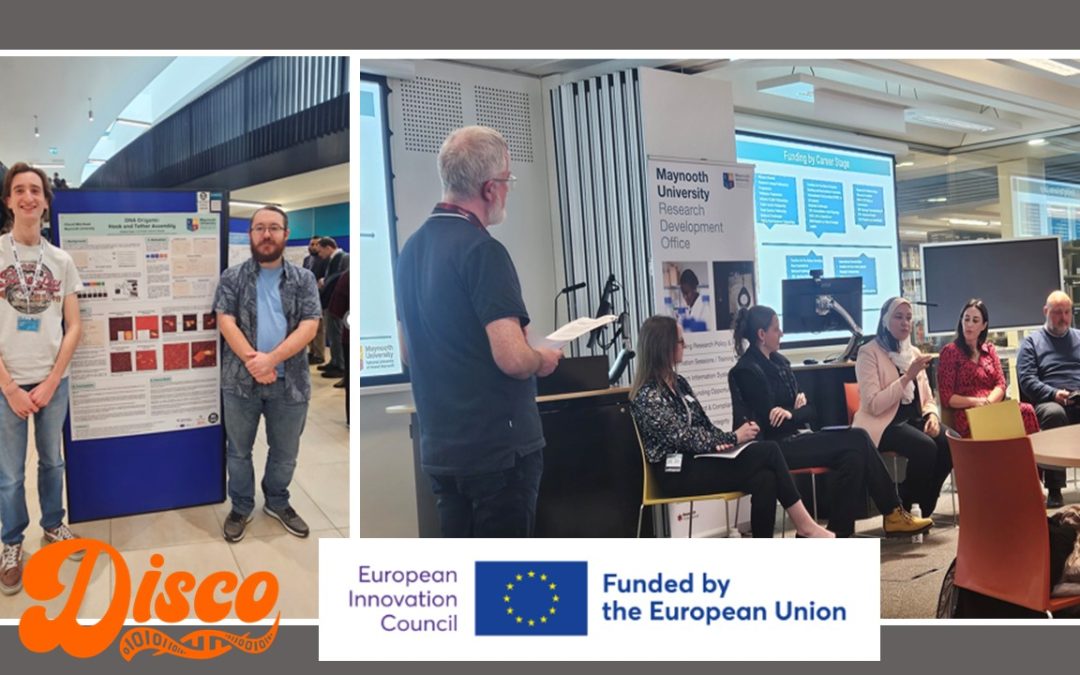
🎓🔦 SPUR students Eoghan Ryan and Daniel Drapeau presented posters on their research work, pictured below with DISCO postdoc Cai Wood
🧪🚀 Assistant Professor Abeer Eshra took part in the Maynooth Sparks 2025: Early Career Research, Pathways & Building Teams panel discussion on how research funding can drive early career research progression. Pictured below with Dr Patrick Boyle, Eilish Lynch, Dr Giulia Gaggioni, Niamh Wycherley, and Rob Kitchin
🌐💡The whole DISCO team took part in the Faculty of Science and Engineering “Research Connections” event in the south campus science museum. Hosted by our Dean Prof. Paul Moynagh and Associate Dean for Research Rob Elmes it provided a forum for faculty members and research students to present their research to colleagues from other departments, fostering awareness of potential areas for collaboration.
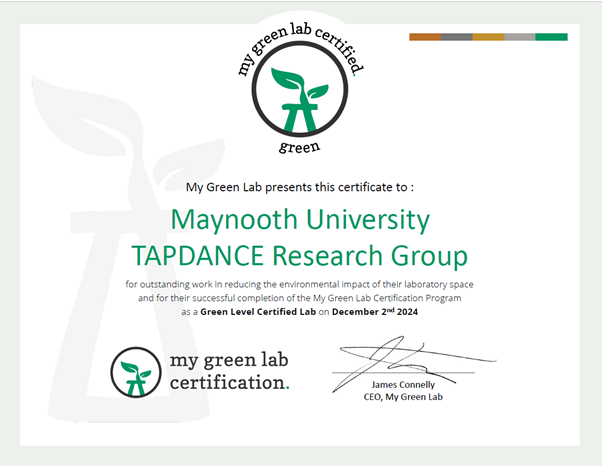
The certification is awarded by My Green Lab in partnership with Impact Laboratories as part of Research Ireland’s Sustainable Laboratory Certification Pilot Programme which was launched in October 2023, with the aim of bringing best practice in sustainable research practices into Irish research labs.
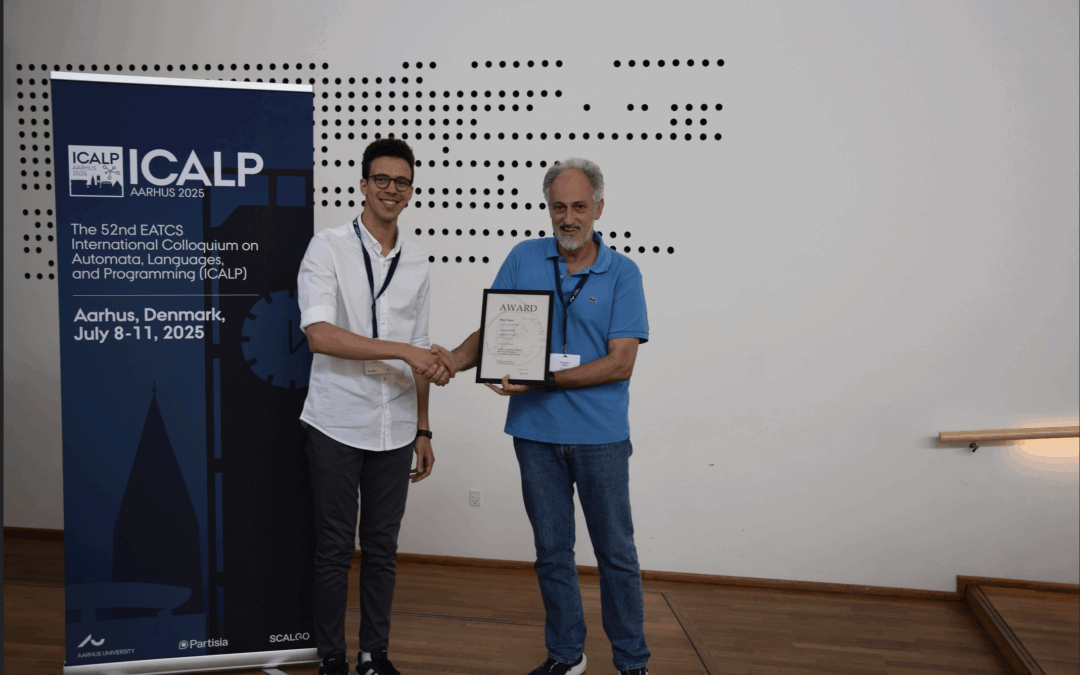
Congratulations to group member Ahmed Shalaby who presented a paper at a joint session of ICALP 2025 at Aarhus University, Denmark, where he received the best paper award.
The paper: An efficient algorithm to compute the minimum free energy of interacting nucleic acid strands, Ahmed Shalaby, Damien Woods. LIPIcs vol. 334, pp. 130:1-130:20. ICALP 2025. It gives the first polynomial time algorithm to compute the most favoured secondary structure of a collection of DNA or RNA strands. Such a structure is called a minimum free energy (MFE) structure. There is a several-decade history to this problem, starting with simple models of DNA/RNA binding, and leading to two important papers: In a SIAM Review paper in 2007, Dirks, Bois, Schaeffer, Winfree and Pierce gave a polynomial time algorithm to find the partition function for a small set of strands, a related problem. However, they left MFE as an open problem. That paper, and others, underlie popular software packages that handle multiple strands, such as NUPACK and ViennaRNA. However, for a large set of strands, large enough to be on a par with the total number of DNA/RNA bases, Condon, Hajiaghayi and Thachuk [DNA27, 2021] showed that MFE is NP-complete, meaning it is unlikely to have a fast algorithm. Our paper shows that if the number of strands is small, as in Dirks et al, there is in fact a polynomial time algorithm. Specifically, the algorithm handles the case of multiple identical strands, a setting which induces a rotational symmetry penalty that was awkward to handle with previous techniques
We use third-party cookies to enable our website's basic functionalities, store your preferences, and provide relevant content. These cookies will only be stored in your browser with your prior consent.
Cookie Preferences
Manage your cookie preferences below:
Essential cookies enable basic functions and are necessary for the proper function of the website.
Name
Description
Duration
Comment Author URL
Stores your website URL entered when posting a comment.
1 Year
Comment Author
Stores the name you enter when leaving a comment.
1 Year
Cookie Preferences
This cookie is used to store the user's cookie consent preferences.
30 days
Used to distinguish between humans and bots to protect the website from spam and abuse. Does not store personal information.
Used to determine inclusion in A/B testing experiments.
18 months
Google Analytics Custom Variable
Stores custom user-level variables defined by the website.
2 years
Google Analytics Traffic Source Tracker
Stores how the visitor reached the site (search engine, link, direct, campaign).
6 months
Google Analytics Session End
Used with __utmb to determine whether the user was in a new session.
Session
Google Analytics Session Start
Works with __utmc to calculate new sessions and visits.
30 minutes
Google Analytics Request Throttle
Used to throttle request rate to improve performance.
10 minutes
Google Analytics Visitor Identifier
Tracks the number of visits and the time of the first, last, and current visit.
2 Years
Google Analytics 4 collects anonymised statistical data about how visitors use the website, helping us improve performance and user experience. No personally identifiable information is stored.